Send a drawing

Low-voltage magnetic track

48V magnetic track light systems

The 48V magnetic family runs the track at low voltage from a driver. That lowers touch risk on the rail, and it's also what makes the slimmest profiles possible. Sampo's 48V range has four members: a 20mm system, a 26mm ultra-thin profile with right-angle and rounded corners, an ultra-thin light-strip (belt) system, and a semi-flexible track.

Choosing between them is mostly about the ceiling. A standard ceiling and a straight run point to 20mm. A low ceiling, or a design with no main light at all, points to the 26mm ultra-thin line. Continuous glowing lines and curved runs have their own answers.
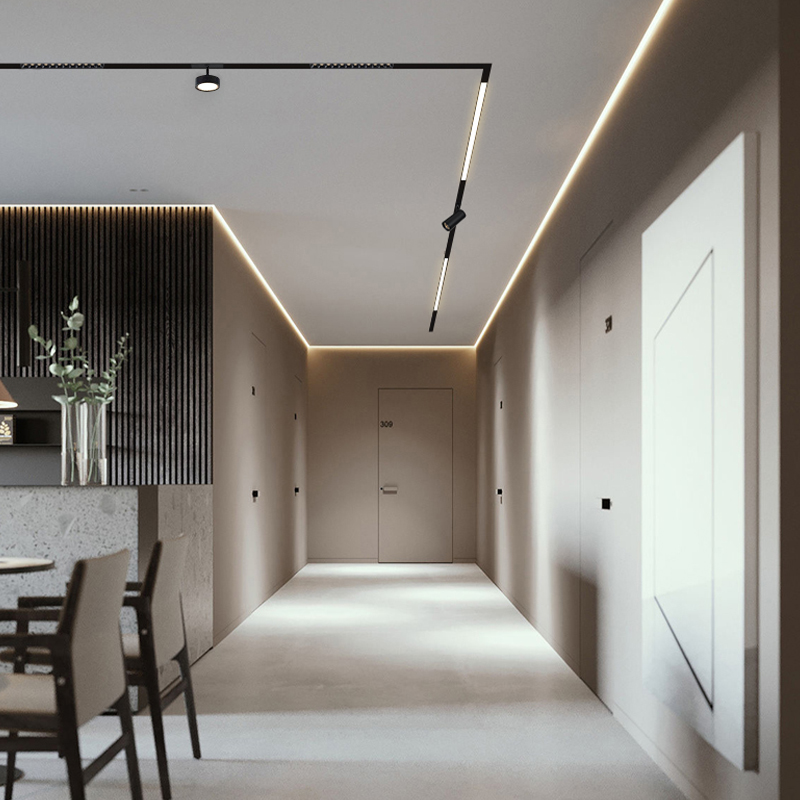
Magnetic track with spot and linear heads along a corridor ceiling
48V sub-series compared
20mm26mm ultra-thinLight-strip (belt)Semi-flexible
Voltage48V48V48V48V
ProfileRegular 20mmUltra-thin 26mmUltra-thin stripBends to follow a curve
Best forStandard ceilings, straight runsLow ceilings, no main lightContinuous lines of lightCurved ceiling features
CornersConfirmed per layoutRight-angle and roundedConfirmed per layoutThe track itself bends
Selector outcomeYesYesAlso considerAlso consider

Why 48V

What low voltage changes

On a mains track the rail carries the supply voltage. On a 48V track it carries a much lower one, which is why 48V is the usual answer when the track is low enough to touch, sits near shelving people reach into, or simply has to satisfy a cautious client.

The trade-off is the driver. Somewhere in the circuit, mains power has to be converted, and that box needs a place. In return, the low-voltage family offers profiles thin enough to sit flush in a ceiling that couldn't take a mains track channel.

48V versus mains, in one list

Touch risk
Lower on 48V
Driver
Needed on 48V; not on M25/M35
Slimmest profile
48V 26mm ultra-thin
Largest heads
M35 on mains

Full high-voltage details: M25 and M35.

48V · 20mm

48V 20mm: the everyday low-voltage track

The 20mm system is where most 48V projects start. It works surface-mounted or recessed in a normal ceiling and carries the regular magnetic fixture families. If low voltage is the priority and nothing else about the room is unusual, this is the one.

Larger rooms can run on it too. Send the list of heads you need and we'll confirm which fit the 20mm profile; if the brief is mostly big display heads on long runs, we'll also show you the M35 option so you can compare.

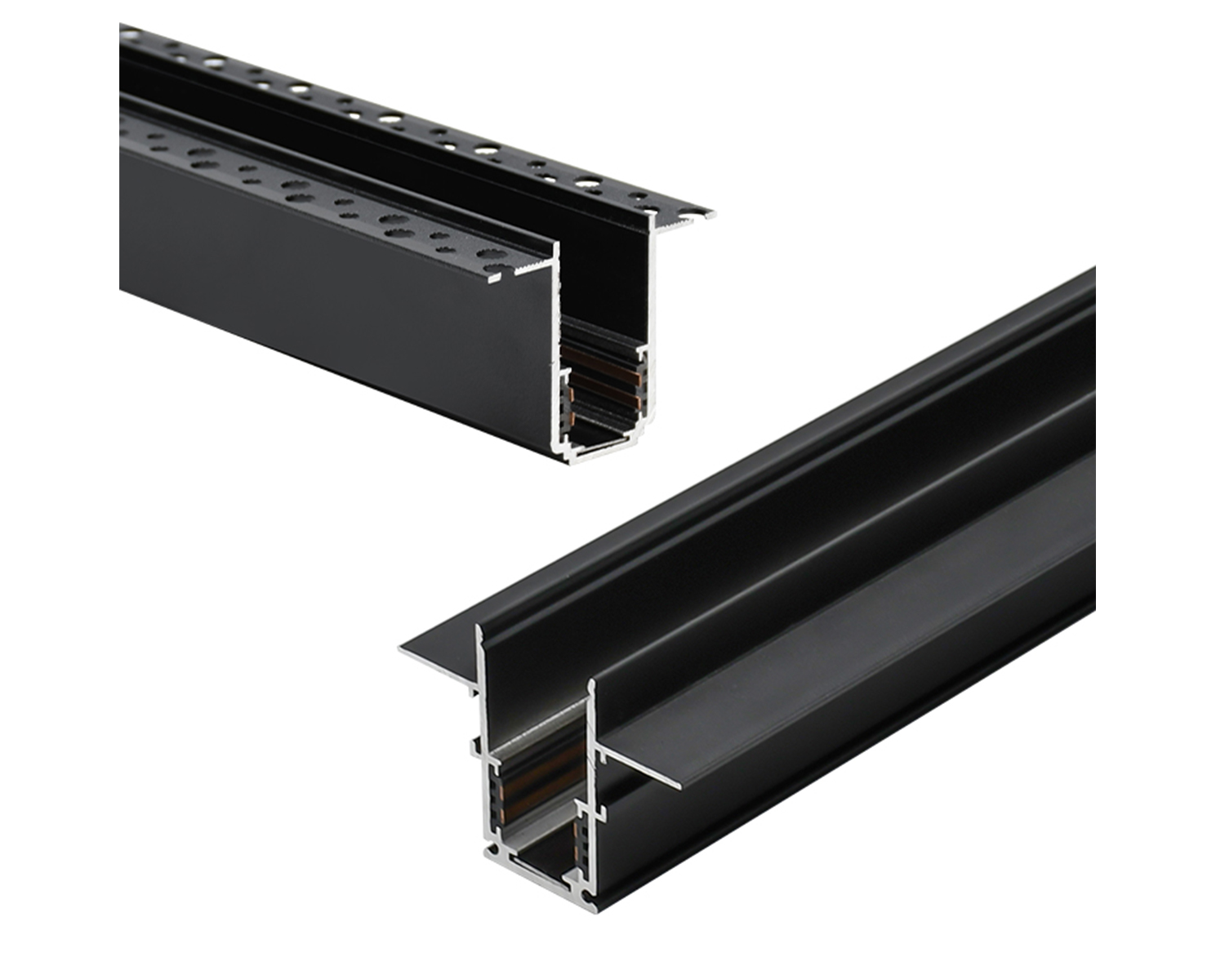
Two black recessed magnetic track profiles with flanges for setting into a ceiling
Slim recessed magnetic track framing a living-room ceiling

48V · 26mm ultra-thin

48V 26mm ultra-thin: the line that almost disappears

The ultra-thin profile is designed for ceilings with little depth to spare and for schemes that drop the central fitting altogether. Right-angle and rounded corner pieces let the line turn with the room, so a single loop can frame the ceiling and carry every light it needs.

Because it's recessed, it has to be planned before the ceiling closes. Send the ceiling build-up and the loop you have in mind, and we'll check the corners and lengths against it.

48V · belt

Ultra-thin light-strip (belt) system

Here the track becomes the light source: a thin, continuous line rather than a row of heads. It's a fit for corridors, cove details and minimal ceilings where the line itself is the design. Control and mounting details depend on the drawing, so we confirm them per project.

48V · semi-flexible

Semi-flexible track

Semi-flexible track bends to follow a curved ceiling feature instead of breaking the line with a corner piece. It's a niche tool, and the radius it can follow depends on the specific product, so send the curve and we'll say whether it works.

Still deciding? Run the two-question selector or read about smart control on magnetic track.

Next step

Send the ceiling, we'll send the system

A plan or a phone photo of the ceiling, the rough run lengths and the voltage you prefer are enough to start. We reply with a suggested series, the profile and the fixture families that fit.